15 April, 2007

ADHD reprints - pt2

Where the Wild Things Were.

Once upon a time, a long long time ago, there were fairy stories designed to tell a moral ‘truth’. Perhaps this style of moralising in children’s stories has gone out of style. Roald Dahl changed people’s perceptions of the fairy tale moral with his Revolting Rhymes. Also the perennial villain of the fairy story, the stepmother has become much more common and much less the villain. Fairy tales and folk stories have always changed, there is no right or wrong version so if you want to change them to your own ends, there is no author to tell you that you can’t.

But if the frightening message is taken out of the fairy tale, where has the moral of the story gone? Well the modern equivalent is the educational story. These stories tend to bring modern social issues into play, Bob Graham’s father figures have ponytails and earrings. Other authors talk about divorce or death in ways that make them great for children who are experiencing these turmoils in their lives. Familiar characters take on new roles Bernstain Bears and the Bully to take one example. These true to life books are designed to children through the stages of psychological growth. By reading about these characters and their bravery in the face of adversity, children gain strategies for dealing with anger, separation from their parents and so on. The similarity between these tales and fairy tales is that the kids don’t always realise that there is a message for them in the story which can allow you to ease them into an issue rather than confront them head on.

It seems that at the moment there is a trend towards this level of reality in children’s fiction but at the same time there is a trend to ‘soften’ traditional fairy stories. Fairy stories and folk tales have as many different versions as there are tellers of stories. So whether Chicken Licken gets eaten is entirely up to you. The same is true of the three little pigs, Goldilocks and so on. One modern rewriting involves stepmothers, once upon a time one could discuss the sins committed by parents by having step parents commit these crimes. Now however stepparents are common enough to make this a problem. After all we don’t want kids to believe that their new stepmother is going to abandon them in the woods. Oh and a big hi to my own stepmother if she’s reading this.

Are fairy tales then, being replaced with a politically correct collection of stories in which kids have two dads or where daycare is the accepted norm? Well yes, but don’t let that put you off the traditional tales. The fantastic thing about Red Riding Hood and her kin is that there is no author around to claim you are changing their work. You can tell red riding hood anyway you want.

Grandma gets eaten

Grandma gets stuffed in the cupboard

Red Riding Hood gets eaten

Red Riding Hood is rescued by a woodcutter

Red Riding Hood is rescued by her father

The woodcutter cuts grandma out of the wolf (and she’s OK)

The wolf escapes (but is never heard of again)

You get the idea, there is no right nor wrong way of telling the story. So why are there so many different ways? Just like our modern tales there is a lesson to be learned. For Red Riding Hood it is don’t talk to strangers. Some people however want to give different morals so the text is changed. Should the wolf/stranger be killed? Where do you stand on capital punishment? These folk tales can prepare children for the things they might face just as more modern stories do.

So once you decide what stories you want to read to the kids, all you have to do is decide how you are going to read them.
For those of you who attend storytime either here or elsewhere you will by now have noticed that there are many vastly different styles of storytelling. If the staff we have here at the Library can present so many different styles of story, think about the vastly different styles parents may have. The great thing about reading for children is that there is no such thing as the wrong style. A quiet reader forces the children to draw closer and listen carefully, a slow reader gives the children a chance to think about each point and perhaps to appreciate the fantastic illustrations that so many children’s books have. Louder (stop looking at me like that) or faster paced storytellers may build excitement and enthusiasm in their audience and so on. And whatever you want to read, traditional, modern, moralizing or just beautiful and full of fairies, the staff at your local public library are more than willing to help you in your search for the perfect kids book for your kids.

14 April, 2007

ADHD reprints - pt1

I've been looking at some stuff I wrote about five or six years ago and I've decided to put it up here on my blog (with some very minor editing) because although I don't know how much it may be of interest to all my readers, I thought it might showcase a change in my writing style. I'm starting with some stuff I did for a library newsletter back when I was a lowly library assistant.
Boys, Books and Your Library.

The comparatively poor literacy levels among boys is the fashionable issue in education at this moment. Your public library is a very good source of information for parents, but perhaps more importantly, once you have the information we are also your number one source of things for boys to read. So what will get boys away from the playstation and into reading? How about a magazine or an Internet site full of tips, tricks and cheats for that playstation? After all, reading about something you understand and enjoy is always easier. For this reason it is a beneficial idea to work with a theme. A big fan of the new Spiderman movie may like a novelisation of the movie, or perhaps the graphic novel. So what is a graphic novel? It is what we in the library call a comic book. Well, not quite but it is something along those lines, lots of graphics to build the storyline.
When looking at things like graphic novels, be aware that many people grade literacy on a scale. This goes from comics at the bottom of the scale through Harry Potter at midpoint and up to Charles Dickens or some other ‘dead white male’ as the top of the scale. Don’t lead boys into this trap, not everyone is going to read Dickens, encourage boys to read what they want to read and make sure that there is lots of that type of book available for them. Reading comics is reading, regardless of what you might prefer.
Literacy comes in a range of formats and if you can theme it then you are onto a good thing. Tie in books exist for TV shows, video games and movies. Don’t be a literacy snob, grab these resources and use them, sure you’re making the wiggles rich but you are utilising the appropriate tools. Popular culture is a great motivator for boys and in so many cases it is motivation rather than ability that is the main problem. For example, while boys often fall behind in written literacy they perform well in spoken literacy, so get them the motivation and their ability will be given a chance. Sport is a great thing for your child to be involved in, be it little athletics (796.43) or rugby. Whatever sport your son plays, try finding books on the sport. A boy who is enjoying rugby may like some basic playing tips from a famous player (796.3332) or if you think they’re up to it, try a biography of a favourite sporting hero.
Another key in getting boys to read is the involvement of fathers and other male role models. A boy is more likely to come into the library to research a hobby if it isn’t seen as a ‘girly’ thing to do. Look for the range of non-fiction that they already favour, collecting pokemon cards, and football stickers from the Sunday Papers. For boys who are into non-fiction the Dorling Graded Readers are a great starting point. These image rich non-fiction books are a springboard into selected subjects and the number of images means that weak or strong readers are equally interested. Boys who see parents involved in aspects of literacy are more likely going to get involved. This doesn’t mean forcing dad to read War and Peace, it means letting him see you doing things with a purpose. This could be doing the business accounts, preparing the rego papers for the car or doing work reports. The key is that it should have a clear purpose, this then illustrates real benefits of literacy rather than pie in the sky school stuff. Mothers are more likely to be supporting school based literacy programs such as homework but fathers tend to come into their own with computers and the Internet. Don’t wait until it is a last minute urgent school assignment to get online. Try to get in early and give the boy a chance to play and do it himself, let him fly off on hyperlink tangents and enjoy the experience (and don’t mention literacy).
Changing boys’ attitude means knowing what your own attitudes are. So if you haven’t been in a library recently stroll in and be surprised by the noise, the chip machines and the wall to wall technology. Primary schools have few male teachers, many libraries suffer a similar lack of male librarians so like it or not whatever male role models a boy already has will colour his perceptions of reading. Try and work out where these role models are, sporting coaches, uncles or older brothers and don’t be afraid to approach them and ask about their reading. Perhaps some role models may not seem like readers at first glance. Finding out more about people, may give you a chance to enlist some help. For those of you who aren’t on the slippery slope of adolescence, try to get your son involved early. Storytime at the library involves videos, crafts, puppets and the occasional book just to get them interested. By introducing them to the library early they have a much better chance of associating the library (and books) with fun, rather than with homework and algebraic long division.
Of course there is an unexpected bonus that occurs when working to increase literacy levels for boys. It would seem that all of the techniques being touted by educational professionals to improve the literacy of boys, will also improve the literacy level of girls (perhaps to an even greater degree).

10 April, 2007

It's the new racism


I've been popping in and out of the library 2.0 pages of ning over the last few weeks or so and have discovered a very disconcerting fact about myself. Yes, it is true, I hate Grey people.
I refuse to go to their pages, I refuse to read their posts, I refuse to accept that they are my equal in any way at all.


I mean, what the hell is wrong with these people? I know that this is a group for librarians and we are not considered the most socially outgoing group in the world, but come on people, make some effort. Put up a picture of your cat, it might make me think less of you but it's better than being a grey person.

04 April, 2007

Who am I


I know you've seen them, proudly displayed on people's blogs. Pictures of the celebrities that they look like. Well, I was tempted and decided to have a look see. Firstly it gave me Chester Bennington (Linkin Park) I could live with that, plus Hugo Weaving - well call me Agent Elrond and Dustin Hoffman. Well I'd like to think that I was more Benjamin Braddock than Raymond Babbitt, but I know some people (my wife) would argue.
All in all though my Ego was pleased, so I don't know what possessed me to test the system further.
But I did. I loaded up a different picture and decided to see how the system went for continuity. Whoops.
this time it decided I was a bit more elfin than Elrond so I ended up not only with Orlando Bloom, but also the ethereal features of Liliana Dominguez and Kate Bosworth. What gives? It's a good thing that I am comfortable with my masculinity because this sort of thing could come as a shock to some people.
So to save my masculinity I uploaded a picture of me from the mustachioed days of November.
Well, to say i got a more masculine spread this time could well be the understatement of this or any other blog this year. You see I went from Lois Lane to Michael Moore. Does this mean that Michael Moore is just Kate Bosworth with a fake beard? Has anyone ever seen them photographed together?
I also managed to get Hugo back although at this point I remembered that he was also Mitzi Del Bra so I'm not sure if this is the improvement I had hoped for. Still, I also scored Billy Bob Thornton and I don't recall ever seeing him frock up.
Well, now it was time for take four, what could happen this time?
Carl Lewis? Umm are you sure magical computer, because I don't see it I mean, skin pigment aside I don't see a shared bone structure or anything.
Still, at least I'm getting away from fat hairy conspiracy nuts whilst at the same time still being masculine. I mean you can't get more masculine than Demi Moore right? I mean, we're talking Lt. Jordan O'Neil. Plus as an added bonus I get Elrond again, so I'm starting to see some sort of pattern.

So, in conclusion this is a fun internet toy which has just made me paranoid about the facial recognition software that is being employed in airports and the like. I'm planning some overseas travel soon and I'm concerned that computers might think I'm a tall black man or perhaps I'm a fat bearded leftie.
But on the fun scale, if you give it a go and you like the first list it gives you, well just leave well enough alone and don't try again it'll just make you sad. Conversely if your first run tells you you look like a cats anus, well it might be worth trying with a different photo because your second attempt might boost the ego back to it's pre damaged levels.

An edit, added for those of you who want to give it a try. My Heritage Face Recognition should let you have at it.
I should have linked it in the first place.

02 April, 2007

This One Goes to the Doubters


Yep,
I haven't placed any match reports for the Rugby Grand Final. Which has lead to some of you making a guess and offering me condolences. So, before this becomes a trend, let me say that we were triumphant running away with the game 16 to 36 (I think) in a fantastic display of wet weather rugby. The wet weather was a bit unexpected in this part of the world, but then the river has flowed four times already this year. So after a season of playing Rugby in the high 30s (Celsius) we finished off in the rain, although the temp was probably still 30c.
I didn't manage to do anything superhuman or of particular note, but I played good solid defensive rugby especially around the breakdowns and did some good backup running in attack, which is all that is expected of a second rower.
And I'm the one with the small child sitting on his lap.

Unattended children in the library


Incite had a bit of a go at addressing unattended children in libraries in the most recent issue. I read it with interest, but unfortunately found little that I could relate to the library here. Our unattended children policy (as I've probably mentioned on the blog before) states that no one under five can come in by themselves.
Odd?
Well, you see these aren't kids being dropped off in the library as a form of daycare. These are kids coming into the library under their own steam. And we have had unattended kids (still in nappies) wander in off the street or wander in under the care and guardianship of their six year old older sister.
"tis damn hard to turn those kids away because the government departments who are supposed to be dealing with things like this are way too under funded to worry about kids who are safe in the library. They're off looking after the kids who need a feed immediately or need to be detached from a dog right now.
Oh, and the image here is stolen from The Onion.

16 March, 2007

AHDH - fugby and rugby


I'm currently deep into an ADHD fug. that is to say, I am not achieving anything at home or at work. I need to sort out travel plans for the UK in June but I still haven't booked or renewed my passport (or applied for passports for the kids). At work I'm doing a great job if I'm on the desk answering questions, or giving tours to school groups (like I did this morning) no planning, all ad lib and all fun. But stick me back in my office and I stare at things then go off and look at the library 2.0 pages on ning and look at my blogroll on bloglines before wandering off to get a chai latte and a copy of the local paper.

I'm not sure why life is so vague at the moment, perhaps it is time to look at adjusting my meds. Come to think about it I had a referral to see the psych to talk about that six months ago and I just didn't get around to making the appointment.

But just to let you know that my life isn't all falling apart around me, tomorrow I play in the Central Australian Rugby Union Grand Final. Yep, this is where the ADHD thing can come in handy. I get to forget that I'm a librarian and instead I get to run at people as hard and fast as I like. I get to tackle people who think they can run at me hard and fast (ha, they think they're tougher than a librarian. Fools!).

Umm, yeah.
Well, I'm 34 now and this is going to be my first attempt at playing in a grand final for anything. So I plan on forgetting about any instinct for self preservation and playing like a mad man.
I'm still unsure of the best tactic for ADHD in rugby. Should I forget to take my meds that day and be full of energy but a little vague on which direction I am running? Should I take the meds and forfeit the insane running in favour of being able to remember the rules? Or perhaps I could go for a double dose and play like some sort of drug addled loon with no sense of his own mortality. So much to decide.

I currently have so much more to say, but every attempt to write it out is ending in me pressing delete as I realise I have lost the ability to communicate. Here's hoping it is temporary.

03 March, 2007

More fame for the ADHD me

Up until this point, the only library catalogue record of my work was one I made myself when i was working at the State Library of NSW. I was working in ILL and adding very basic records to the computer catalogue whenever we had to send out an item which was only on the card catalogue. One day in a haze of undiagnosed ADHDness, I decided to catalogue myself. I got myself a barcode, put it on a bit of card and wrote on it some details about myself. I then gave it a call number and put it down in the stacks. It was a circ on the fly type record. So it would only have been found if someone was searching for me under author or title, but it amused me no end to know it was there.

More recently I received this email...

[snip] The National Library of Australia aims to build a comprehensive collection of Australian publications to ensure that Australians have access to their documentary heritage now and in the future. The Library has traditionally collected items in print, but it is also committed to preserving electronic publications of lasting cultural and research value.

PANDORA, Australia’s Web Archive, was set up by the Library in 1996 to enable the archiving and provision of long-term access to online Australian publications. Since then we have been identifying online publications and archiving those that we consider have national significance. Additional information about PANDORA can be found on the Library's server at: http://pandora.nla.gov.au/index.html

We would like to include the ADHD Librarian blog in the PANDORA Archive [/snip]

So now I am searchable as an author on Libraries Australia.

Wheeeeeeeeeeee
Fame,
I wana be a blogger
I wana learn how to write
Fame

So,
If any of you librarians out there want to increase my fame (awww go on, please I'll be your best friend)
feel free to add this record to your own library catalogue (assuming you have permission of course, I have learned the error of my earlier ways).

a reader asks...

Hi John,

By fortunate coincedence I came across your blog and am writing to inquire if you would be willing to help me in my career planning research. I have ADD and work in a technical services division for my local government. I have been pondering the idea of pursuing a Library Science career change, beginning with an undergraduate degree in Information Sciences and English.

If you are willing to answer any, or all of my questions, I have included them below for your consideration.

Thanks for considering my request.

Best regards,

[Person whose name I edited out…]

So on with his questions.

  • Describe a typical day at work..

That’s a hard one, Librarians have a very varied life. For me (as a children’s librarian) I have two types of days.

Firstly, there are those times when I am setting things up for school holiday activities. So I am chasing up performers (clowns puppeteers etc) and looking for people to teach things like cartooning of some sort of craft activity. It’s kind of like being a booking agent only you know if you can’t get a clown then you’re going to have to paint yourself up. It wasn’t so bad in a major metro area, but now I’m remote it is damn hard.

Then there are those days when I am working on the collection, so I am looking at catalogues and working out where our strengths and weaknesses are in our collections. Then I buy the books and catalogue them into the collection. I have an assistant who does the end processing (stickers, stamps, covering). I also need to keep an eye on the books we have and remove the out of date and replace the damaged.

Add into both of these, shifts on the service desk (reference work and circulation work).

Then there are meetings, library senior team and whole of staff, plus I am on the Electronic Document Management team for the whole of Council and I am currently working on setting up business planning software (again a whole of council gig).

In the past though I’ve worked in jobs which were pure cataloguing, sitting at a desk all day with a pile of engineering texts which need to be added to the collection. Not ADHD friendly, unless you have a good dose of hyperfocus in there. I always managed to find ways to vary my duties though, but that is very dependant on the people around you.

  • How many hours do you normally work in a week?

I work a 38 hour week. But I do 8 hours a day, which gives me an extra day off a month. I also work occasional weekend shifts, which can increase my pay or give me extra days off. That though depends on the award you work under and the laws of your state/country.

  • What kind of qualities does a librarian need?

Traditionally, it has been attention to detail and a good memory. These days however, there is more computing ability needed and an increasing need for flexibility and the ability to switch tasks at a moments notice. There are a range of library jobs, and therefore a range of library skills. Some big libraries have their own IT department, some work with specific jobs for specific people, so cataloguers never see the light of day and circ staff never answer a complicated reference question. Others (and smaller libraries) vary things a lot, so that everyone deals with the public and everyone shelves the returned books. The theory there is that if you never see the users and never pick up the books, then you loose focus on what you’re there for.

  • What do you like best about your job? What do you like least?

Best, is the unexpected reference question. Some sort of research to really sink the teeth into. Plus Storytime for the preschoolers can be a hell of a lot of fun.

Least? The political bullshit that comes from having to work for local government. In particular the way that libraries are often overlooked come budget time.

  • How ADHD friendly do you consider your career? Do you have any special strategies for coping with your ADHD as a librarian?

It is as ADHD friendly as you make it. I have had a hard time with some supervisors who find my lack of concern concerning. But I have also had great bosses who understand that I leap from task to task.

It depends on the library, a big library can end up with you in a very narrowly defined role, while a small one will often give each staff member a wide variety of roles. In the second option I think ADHD can be a big advantage.

My special strategy for coping is to be so damn good at the things I enjoy, that people don’t notice the half arse job I so often do with things I don’t like.

  • What do you see as the potential for growth in this field?

There is so much debate as to the role of librarians in a world where everything is online. Some people think we’re dinosaurs and we’re going to die out. Others think that because we’re all about finding information that we’re on an upswing. The more information there is laying around, the harder it is for the untrained to find the right thing.

I go with the second view. Plus, although we’re not all about books, there is still a place for the physical book.

  • What can I do now to help me find employment in this field?

That depends on where you are. In Australia you can still do a library recognised qualification as an undergrad, so that might be worth looking at.

In the US you need a masters, which would mean you need to do your Information Sciences and English undergrad first.

I’d recommend the library post grad option even in Australia, I just feel it gives you more options down the track. Plus as an ADHD person, there is a lot more flexibility in the subjects you choose and enjoying the study is a big part of the battle to complete it. Although in Oz, you only need to go to Grad Dip rather than masters.

I think the UK also want a masters, but I can’t remember off the top of my head and couldn’t be bothered to look it up.

http://alia.org.au/education/ Australia
http://www.ala.org/ala/education/educationcareers.htm USA
http://www.cilip.org.uk/jobscareers/ UK

or try looking online for the professional body of your country,

I'd also recommend trying to get yourself some library work now, rather than waiting till you’re qualified. Library assistant positions can be valuable experience for when you become a librarian. In particular because the qualifications are all theoretical rather than practical. You’re already in local government so it might be as easy as asking for a transfer to the local public library. Otherwise, start looking for library work wherever you can find it. The tech services experience should stand you in good steed with potential employers.


28 February, 2007

it's all about placement


Sometimes, where a paper decides to run an image can be confusing. I thought this man sodomised nations but now it seems like...

23 February, 2007

All talk, no protest


For all my talk on this blog about the American gulags in Gitmo, I managed to meet the 'merkin ambassador this week and I failed to raise the issue. My 'I (heart) David Hicks' T-Shirt just didn't arrive in time.
Oh, OK I didn't even order one. But I did meet the ambassador.
He dropped in to the public library to say g'day to me. Umm, look I know I am given to storytelling, but it is true damn it. You see in December the embassy donated some books to us via the Joint Defence Facility at Pine Gap and it turns out that Mrs ambassador was on the library board of Atlanta ore somewhere like that, so she's a public library groupie (we get lots of them).
So, I said g'day thanks for the books and then sat back and watched our puzzled patrons try and work out who this bloke was and why the library had so many large men with headphones wandering around.

I did however manage to talk gitmo with the head of the Pine Gap base who had also dropped in at the same time, well I say discussed, I mean made jokes about but that's my style. I'm not sure that he quite knew what to say in reply, but I had fun anyway.

Conferencing again

I've just had another conference paper accepted, yeah w00t and spl0rk!

This time it is for the Australian School Librarians Association, XX Biennial Conference. Learning, Literature and Literacies, 2nd to 5th October 2007 Adelaide Convention Centre. so, loyal readers, here is your preview...


Their Ghosts Stalk the Shelves:
the information seeking behaviours of the millennial generation

Millennials, Generation Y, the Myspace Generation, MyPod Generation, Generation Next, Nintendo Generation, the Cynical Generation. Call them what you will, the students coming through our schools at the moment are in many ways more prepared for what the education system will throw at them, than any generation before them. They are full of confidence in their own ability and so sure of their own information finding abilities that most fail to see any need (beyond some recreational reading) for their school and public libraries. This high level of information literacy should have advantages both for them and their librarians but many of them are failing to engage with libraries and are failing to see the relevance of outmoded concepts, like authority, in their information sources.

So how do we show a cynical generation that we have something to offer?

This paper will examine ways in which librarians can be integrated into student’s learning. It will look at methods librarians can use to draw the students in. It has been suggested that millennials find referrals from their contacts to be more valid than information gathered from more traditional sources. These students don’t know of a time before the internet, so they are not pen and paper thinkers, they are not lineal thinkers, they think in a web. But not the old web, these are the people who think web 2.0. So, this paper will consider questions like; does your library have a myspace page? Have you considered adding all of your students to your friends list? Do you edit wikipedia articles and if you do, how do you make your students aware just how hip and trendy you are. And more to the point, will editing wikipedia no longer be cool by the time I present this paper. Will everyone under the age of 30 leave myspace en masse once it is overrun by librarians and how can you possibly stay one step ahead of all these trends?

06 February, 2007

just like working in a public library


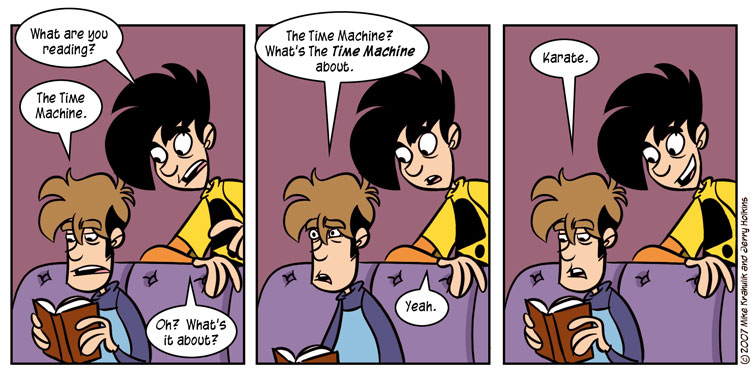
This offering from penny arcade is just so much like the life you have offering people advice on what to read.
Ah, the public. They're so stupid.

Oh, and for the record, if you don't read Penny Arcade then you are a total n00b.

02 February, 2007

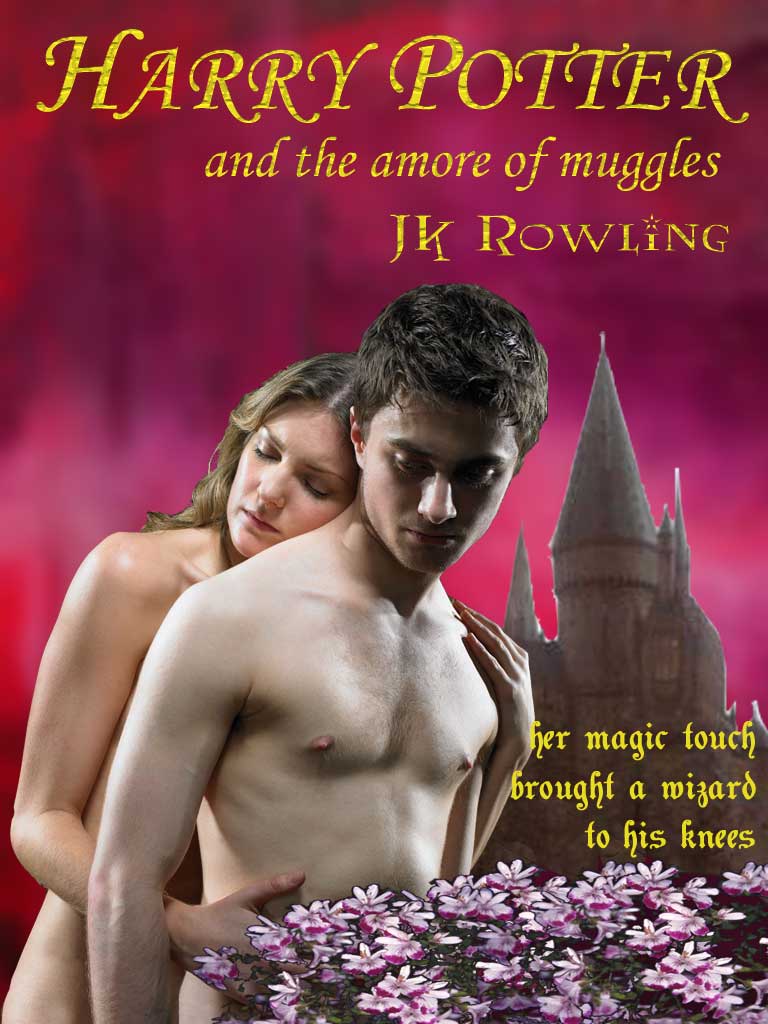
Cover of New Harry Potter Novel

One of the fantastic things about working in a library is the access to information well before most of the world knows about it.
Oh the power!
So here it is,
the art for Harry Potter Book Seven.
Remember you saw it here first.

Scott Adams Is A Brilliant Philosopher: who wants nothing more than to make the world a better place

PZ Myers is a biologist and associate professor at the University of Minnesota, Morris. Unfortunately he is also a self-important, humorless, autofellating, ass hat, or at least that is one theory which Scott Adams has put forward.
Having been a reader of Dilbert books for some time, and a reader of Scott Adams own blog for the last little while I am inclined to accept Adams word on this. But then, I also like to think I have the power to make up my own mind (Adams would assert that free will is an illusion, and perhaps that this means I'm not really making up my own mind). Still I visited Myers' blog pharyngula and had a look at his post on Adams' writing. In it Myers admits that he is humourless, although, like many humourless people he then criticises the humour of Adams. Fool, he can't understand that as someone humourless he is in no position to judge humour in others. Imagine if you will, I am a chef (I am not hence the imagination bit) you have come to my restaurant despite having no sense of taste. Am I then going to accept your complaint that the soup is flavourless? Myers doesn't admit to being an autofellating, ass hat, and I can't comment on that from reading a couple of blog posts, but he certainly comes across as self important.

Still, enough deriding of the man who criticised my guru. Onto the meat of the point, why should you accept Adams is a brilliant philosopher, seeking to make the world a better place.
Firstly I would point you to his classic works on the stupidity of western corporate culture, The Dilbert Principle and The Dogbert Top Secret Management Handbook either of which you should find at any half decent bookshop or public library. These works, while satirical are in fact profound reflections on the nature of the world in which many of us are forced to exist. Adams finds ways to illustrate and express what many of us have felt but been unable to articulate.

He goes further on his blog (and in his book God's Debris) with his discussions of theology (of a type), cosmology and free will. For example on a recent post he discusses free will. "My understanding of the human mind is that our reasons are just rationalizations for our urges."
He also expresses why he keeps posting on these topics despite the many cries for him to 'stick to humour'. Or perhaps, how he rationalises his decision to keep posting.
"The part I like the most is the comments. I like the smart comments because they make me think. I like the dumb ones because they fascinate me and make me feel smart at the same time. I like the funny comments because they make me laugh. And the whole process makes me feel connected to something larger than myself."

So despite being a Christian and a believer in free will, my Guru is an atheist who believes we are all 'moist robots'. After all, if you can't laugh at yourself then you're obviously a self-important, humorless, autofellating, ass hat.